Etna
FVXX01 at 03:00 UTC, 18/08/26 from LFPW
VA ADVISORY
DTG: 20260818/0300Z
VAAC: TOULOUSE
VOLCANO: ETNA 211060
PSN: N3744 E01459
AREA: SICILY VOLCANIC PROVINCE
SOURCE ELEV: 3357M
ADVISORY NR: 2026/104
INFO SOURCE: VONA, INGV WEBCAMS, SAT IMAGERY
AVIATION COLOUR CODE: RED
ERUPTION DETAILS: ERUPTION AT 20260816/1620Z ONGOING ERUPTION
DECREASING
OBS VA DTG: 18/0300Z
OBS VA CLD: SFC/FL150 N3748 E01503 - N3645 E01841 - N3536 E01800 -
N3736 E01500 - N3748 E01503 MOV SE 25KT FL050/200 N3536 E01800 -
N3645 E01839 - N3521 E02315 - N3400 E02342 - N3200 E02130 - N3536
E01800 MOV SE 20KT
FCST VA CLD +6 HR: 18/0900Z SFC/FL150 N3757 E01503 - N3538 E02027 -
N3408 E01856 - N3730 E01442 - N3757 E01503  FL050/200 NO VA EXP
FCST VA CLD +12 HR: 18/1500Z SFC/FL150 N3438 E02015 - N3342 E01824 -
N3527 E01700 - N3733 E01445 - N3748 E01500 - N3618 E01806 - N3438
E02015
FCST VA CLD +18 HR: 18/2100Z SFC/FL150 N3430 E02006 - N3351 E01815 -
N3530 E01703 - N3736 E01448 - N3751 E01506 - N3621 E01809 - N3430
E02006
RMK:  ASH EMISSION DECREASING. ASH CLOUD MAINLY  COMPOSED OF WATER
AND SO2 AND EASTERN CLOUD  DISSIPATING. QVA NOT PROVIDED DUE TO THE
LOW   INTENSITY OF THE EVENT.
NXT ADVISORY: NO LATER THAN 20260818/0900Z=
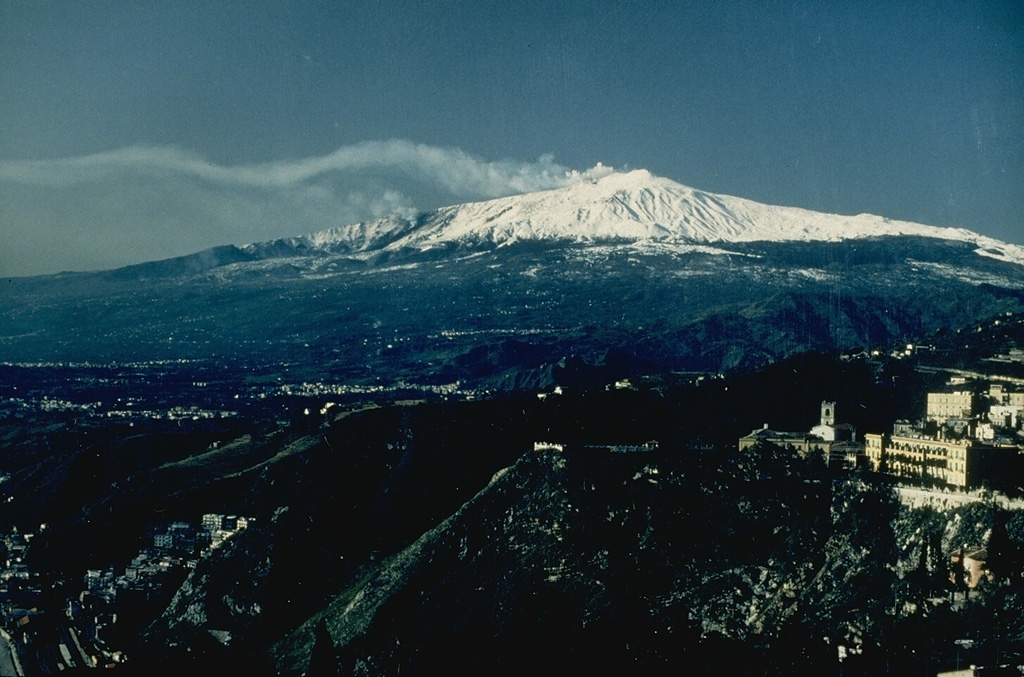
Etna
Mount Etna, towering above Catania on the island of Sicily, has one of the world's longest documented records of volcanism, dating back to 1500 BCE. Historical lava flows of basaltic composition cover much of the surface of this massive volcano, whose edifice is the highest and most voluminous in Italy. The Mongibello stratovolcano, truncated by several small calderas, was constructed during the late Pleistocene and Holocene over an older shield volcano. The most prominent morphological feature of Etna is the Valle del Bove, a 5 x 10 km caldera open to the east. Two styles of eruptive activity typically occur, sometimes simultaneously. Persistent explosive eruptions, sometimes with minor lava emissions, take place from one or more summit craters. Flank vents, typically with higher effusion rates, are less frequently active and originate from fissures that open progressively downward from near the summit (usually accompanied by Strombolian eruptions at the upper end). Cinder cones are commonly constructed over the vents of lower-flank lava flows. Lava flows extend to the foot of the volcano on all sides and have reached the sea over a broad area on the SE flank.
View Full Volcano Details